‘Abdu’l-Bahá in America

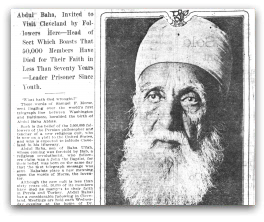
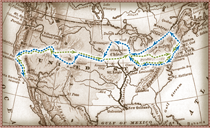
In 1912, ‘Abdu’l-Bahá, the son of the founder of the Bahá’í Faith, traveled from coast to coast across America after a lifetime of imprisonment and persecution.

He called on America to become a land of spiritual distinction and leadership and gave a powerful vision of America’s spiritual destiny — to lead the way in establishing the oneness of humanity.

‘Abdu’l-Bahá shown here (at center) with Bahá’ís at Lincoln Park, Chicago, Illinois, USA, in 1912.

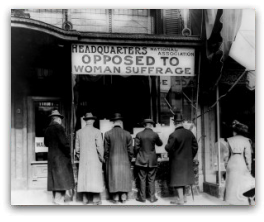
Perhaps the most prominent social message that ‘Abdu’l-Bahá brought to the West was the need for international peace, which he called “the most momentous question of this day.” While much of the popular discussion involved the political requisites to peace, ‘Abdu’l-Bahá focused on social and spiritual issues, linking universal peace with such topics as women’s suffrage, a world tribunal, collective security, the necessity of religious unity and the need for justice.

Unity in diversity : watchword of the Bahá'í Community

Abdu’l-Bahá described gender equality through the powerful analogy of a bird attempting to fly:

The world of humanity is possessed of two wings: the male and the female. So long as these two wings are not equivalent in strength, the bird will not fly. Until womankind reaches the same degree as man, until she enjoys the same arena of activity … humanity cannot wing its way to heights of real attainment.

'Abdu'l-Bahá called for greater education and opportunity for women.

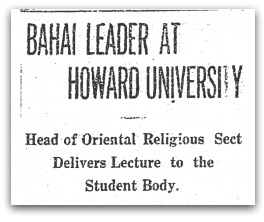
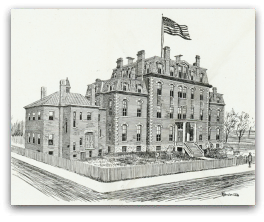
In 1912, the country was torn with racial division, and “separate but equal” was the highest level of interracial relations to which the nation aspired. ‘Abdu’l-Bahá challenged America to go beyond tolerance, to embrace diversity completely, and to demolish racial barriers in law, education and even marriage.

Prejudice is a learned behavior.